
Cricket Toss Betting Odds & Match Predictability
 Available in US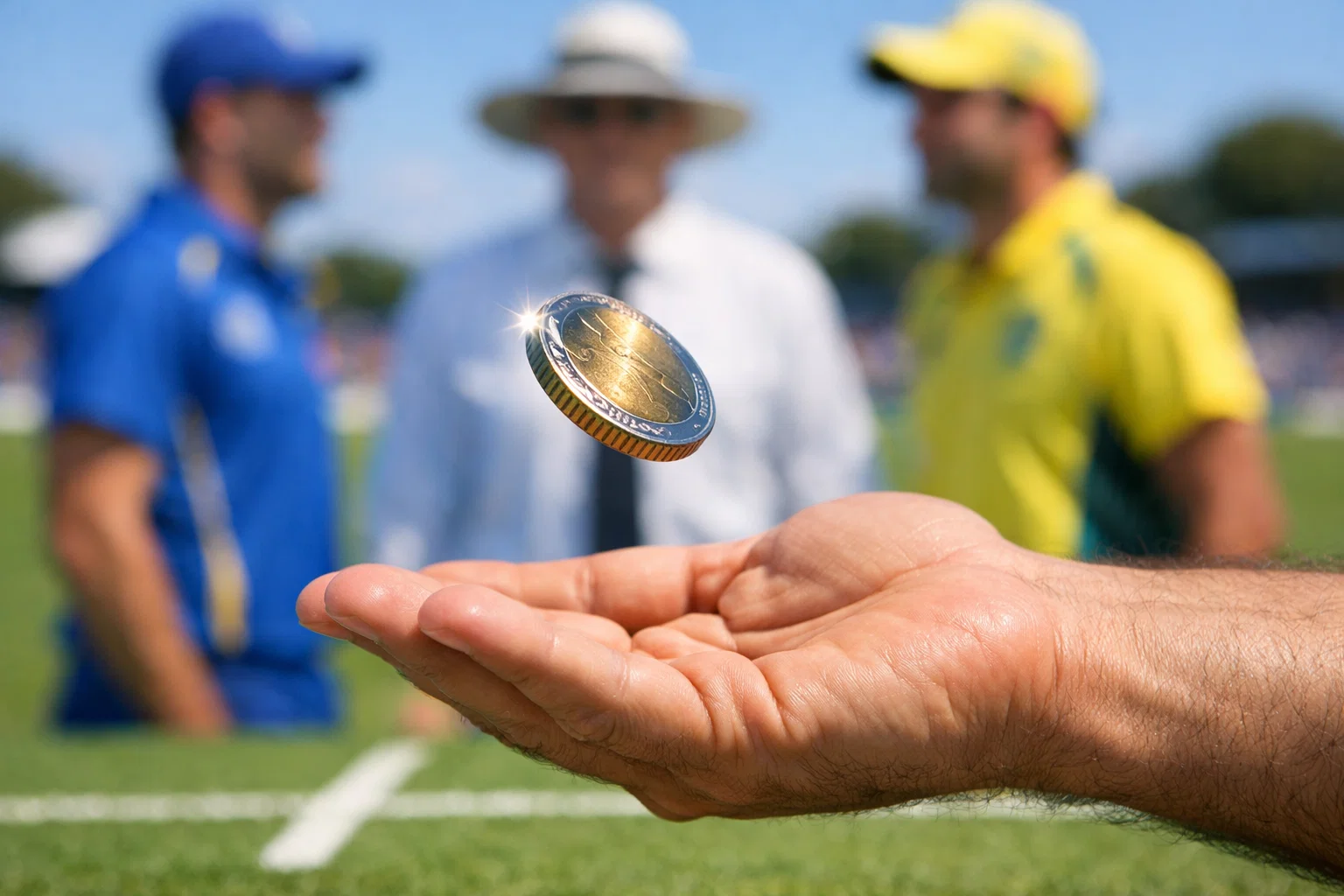
The toss is the only moment in a cricket match that is genuinely random. Two captains walk to the middle, a coin spins in the air, and the outcome determines which team bats first and which bowls. It takes five seconds and involves zero skill. Yet the toss has a measurable impact on match outcomes that varies dramatically by format, venue, and conditions — and the betting market does not always price that impact correctly.
Toss betting itself is a niche market: you are simply backing one captain to call correctly, which is a pure 50/50 proposition with no analytical edge. The real value of understanding the toss lies not in betting on the toss itself but in betting immediately after the toss, when the result and the captain's decision provide information that the pre-match odds have not yet fully absorbed. This guide analyses the statistical impact of the toss across formats, evaluates which conditions amplify the toss advantage, and shows you how to use the toss as a live-betting trigger.
Statistical Impact of Winning the Toss
The impact of the toss on match outcomes has been studied extensively, and the data tells a nuanced story. Across all international cricket, the team winning the toss wins the match approximately 52-53% of the time — a small but real advantage. However, this aggregate number masks enormous variation by format and conditions.
In Test cricket, the toss advantage is strongest on pitches that deteriorate significantly over five days. On subcontinental pitches where batting last is extremely difficult — Ahmedabad, Nagpur, Galle — the team winning the toss and batting first has won over 60% of matches in recent years. On pitches that remain relatively consistent — the MCG, many English grounds — the toss advantage drops below 52% and approaches statistical insignificance. The toss matters most when the pitch changes dramatically from day one to day five, and least when conditions remain similar throughout.
In ODI cricket, the toss advantage is moderate and primarily driven by the choice to bat first or chase. Across the past decade of ODI cricket, the team chasing has won approximately 53-55% of matches globally. This chasing advantage is amplified at certain venues and in day-night matches where dew assists the team batting second. However, the toss advantage in ODIs is less decisive than in T20 cricket because the longer format gives the team batting first more time to post a competitive total even if conditions change.
In T20 cricket, the toss has the most significant and consistent impact. The team winning the toss in T20 internationals — particularly in day-night matches — wins approximately 54-56% of the time. At dew-affected venues, this figure can reach 60-65%. The reason is structural: T20 matches are short enough that the conditions in the second innings (dew, slower pitch, tired bowlers) differ meaningfully from the first innings, and the toss winner can choose which set of conditions to exploit. The toss in T20 cricket is not a coin flip that happens to precede the game — it is a strategic decision that directly shapes the contest.
Format-Specific Toss Dynamics
The captain's decision after winning the toss is not random — it reflects tactical reasoning based on the pitch, the weather, the team's strengths, and historical patterns at the venue. Understanding these decision patterns helps you predict what a toss winner will choose and how that choice should affect the odds.
In Test cricket, captains overwhelmingly choose to bat first when they win the toss, particularly on subcontinental pitches and at venues with a history of pitch deterioration. The logic is sound: batting first on the best available surface, posting a large total, and then bowling at the opposition as the pitch worsens is the highest-probability path to victory. Exceptions occur when the pitch is green and the captain believes their bowling attack can exploit the early-morning conditions — but even in these cases, the decision is often to bat first and absorb the difficult conditions rather than risk losing early wickets while bowling in conditions that will ease later.
In T20 cricket, the decision calculus has shifted decisively toward bowling first. In the IPL and most other major T20 leagues, the majority of toss winners choose to bowl first and chase, driven by the dew factor, the psychological advantage of knowing the target, and the statistical evidence that chasing teams win more often. This trend is so pronounced that in some IPL seasons, over 70% of toss winners have elected to bowl first. When a captain wins the toss in a T20 match and chooses to bat first — against the prevailing trend — it signals specific intelligence about the pitch or conditions that the market should pay attention to.
In ODI cricket, the decision is more balanced and depends heavily on the specific venue and conditions. Captains who win the toss in ODIs are roughly evenly split between batting and bowling, reflecting the format's greater tactical flexibility. The ODI toss decision carries less informational value than the T20 decision because the split is less predictable and the reasons behind the choice are more varied.
Venue-Specific Toss Impact: Where the Coin Flip Becomes a Factor
The toss advantage is not distributed evenly across venues, and understanding which grounds amplify the toss impact is the most actionable insight for bettors. The venues where the toss matters most share one or more of these characteristics: significant dew in evening sessions, rapid pitch deterioration, or a strong historical bias toward batting first or second.
Subcontinental venues — particularly Ahmedabad, Nagpur, Galle, and Colombo — produce the strongest toss advantages in Test cricket. At these grounds, the team batting first on a fresh pitch has a win rate exceeding 60% over the past decade. The pitch deterioration at these venues is so severe that batting last becomes an exercise in survival rather than run-scoring. The pre-match odds at these venues should incorporate a significant toss premium for the team batting first, but the adjustment is often insufficient — the sportsbook's model uses global toss-impact data rather than venue-specific figures.
Indian T20 venues — especially those used during the IPL evening matches — produce the strongest toss advantages in limited-overs cricket. At grounds like Wankhede Stadium in Mumbai, Eden Gardens in Kolkata, and the Rajiv Gandhi International Stadium in Hyderabad, the dew factor transforms the second innings into a batting paradise and a bowling nightmare. The toss winner at these venues chooses to bowl first with near-universal consistency, and the team chasing wins at rates approaching 60-65%. If you are betting on IPL matches at these venues, the toss result should be a mandatory input into your live-bet decision.
English and New Zealand venues produce the weakest toss advantages globally. The moderate climate, consistent pitch behaviour, and relatively even distribution of wins batting first versus second mean that the toss is close to irrelevant at most English grounds. At venues like Lord's, The Oval, and the Basin Reserve in Wellington, the toss-winner's win rate is within 2-3% of 50%, which is statistically indistinguishable from random chance. At these venues, the toss should have minimal impact on your betting decisions.
Captain Decision-Making Patterns
Individual captains have identifiable toss-decision patterns that can inform your post-toss betting. Some captains are consistently aggressive — they will bowl first at any T20 venue regardless of conditions because they back their bowlers to restrict and their batsmen to chase. Others are more conservative, preferring to bat first and set a target. These tendencies are visible in the historical record and are worth tracking.
When a captain deviates from their established pattern — when a captain who always bowls first in T20 cricket chooses to bat first — it signals that they or their team management have specific information about the pitch or conditions that overrides their default preference. This deviation is informational: it suggests that the pitch may not be as good for chasing as the venue history implies, or that the team has identified a first-innings advantage that is not visible in the public data. These deviations are rare but highly significant, and the market almost never adjusts quickly enough to reflect their implications.
Captaincy changes within a franchise or team can also shift toss-decision patterns. A new captain may bring a different tactical philosophy that changes the team's approach at the toss. If a franchise that has consistently bowled first under one captain starts batting first under a new captain, the change in approach may take the sportsbook's model several matches to incorporate. The early matches under a new captain's toss-decision regime are where the sharpest mispricings occur.
The toss decision also interacts with team composition in ways that affect multiple markets simultaneously. A captain who wins the toss and bowls first is implicitly backing their bowling attack to restrict the opposition — which should shorten the odds on the under for first-innings runs and lengthen the odds on the top batsman from the batting team. A captain who bats first is backing their batting lineup to set a total — which should shift the match-winner and total-runs markets accordingly. These secondary market effects are where the most overlooked post-toss value often hides.
Five Seconds That Shape Ninety Overs
The toss takes five seconds. The analysis of its implications takes considerably longer. A coin lands on one side, a captain speaks a few words into a microphone, and the entire betting landscape for the next three to eight hours shifts. The sportsbook's algorithm processes the toss result and adjusts the odds within seconds. The question — the only question that matters for a bettor — is whether the algorithm's adjustment is correct.
At most venues and in most matches, the algorithm is close enough that the post-toss odds offer no meaningful edge. The toss matters, but the market prices its impact adequately. At the venues where the toss matters most — the dew-heavy Indian grounds, the deteriorating subcontinental Test pitches, the specific conditions where batting first or second confers a structural advantage — the algorithm's adjustment is often too small. It underestimates the impact because it is calibrated to global averages rather than venue-specific realities.
The bettor who has studied the venue-specific toss data, who knows which grounds amplify the toss advantage beyond what the model expects, and who is ready to act in the minutes between the toss and the first ball has access to one of the most reliable edges in cricket betting. It is an edge built on a coin flip — which is ironic, given that the coin flip itself offers no edge at all.
