
Test Match Betting Odds & Five-Day Markets
 Available in US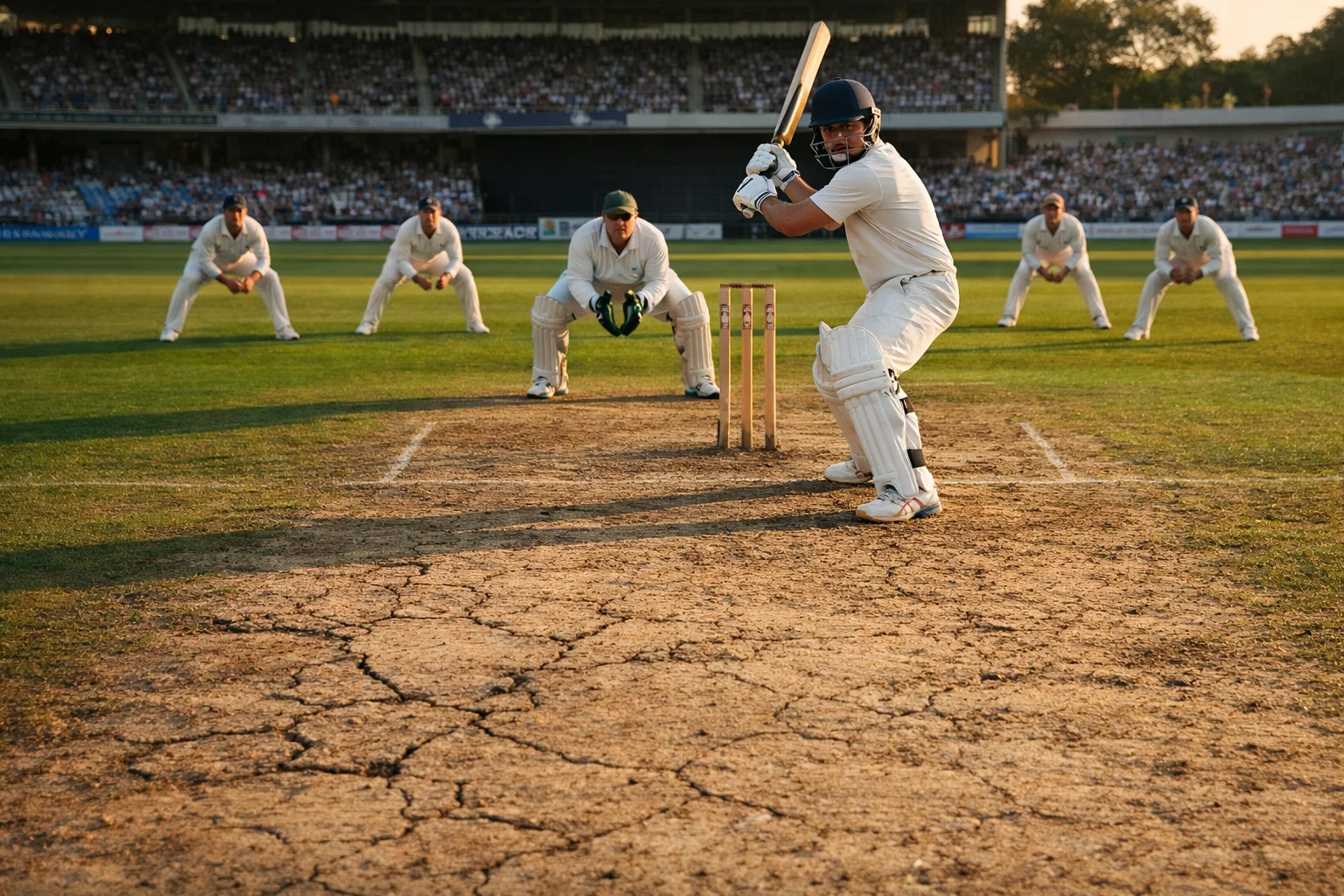
Test cricket is the format that most casual bettors ignore and most serious bettors love. The five-day duration, the three-way match result market, and the constantly shifting dynamics of pitch deterioration create a betting landscape with more depth and more opportunity than any limited-overs format. Where T20 betting rewards quick decisions and fast reflexes, Test match betting rewards patience, position management, and an understanding of how cricket matches evolve over days rather than hours.
The draw market alone makes Test cricket unique in the betting world. No other major sport offers a regularly occurring third outcome that can be strategically bet on, traded, and hedged across multiple days. Add session-by-session wagering, pitch deterioration analysis, and the ability to trade positions as the match unfolds, and Test cricket becomes the most intellectually demanding — and potentially the most rewarding — form of cricket betting available.
The Draw Market Dynamics in Test Cricket
The draw is the feature that makes Test match betting fundamentally different from limited-overs betting. In a Test match, the draw occurs when the match runs out of time before both teams have been bowled out twice. This makes it a result driven by time, weather, and pitch behaviour rather than simply by which team plays better. A team can dominate four and a half days of a Test match and still draw if rain washes out the final session.
Pre-match, the draw is typically priced between 3.50 and 8.00 depending on the venue, the teams, and the weather forecast. At grounds with a strong history of results — like the Gabba in Brisbane, where the pitch offers pace and bounce that produces wickets quickly — the draw price is long. At grounds where weather interruptions are common — like Manchester or Nottingham in England — the draw price is significantly shorter because the probability of lost time is higher.
The draw market becomes most interesting during the match itself. On the first morning, the draw is priced based on pre-match assumptions. By the end of day two, the match has provided real information — the pitch's actual behaviour, the run rate, the weather pattern — and the draw price adjusts accordingly. A match where both teams have posted large first-innings totals and only two innings have been completed by the end of day three will see the draw price shorten dramatically, because there is not enough time remaining for both teams to bat again and produce a result. Conversely, a match where the pitch is misbehaving and wickets are falling quickly will see the draw price drift out, because a result becomes increasingly likely.
The strategic approach to draw betting is to identify matches where the pre-match draw price does not adequately reflect the conditions. If a Test match is scheduled at a ground where three of the last five Tests have been drawn, and the weather forecast shows rain on days three and four, the draw probability may be 35-40% — but the pre-match price might imply only 20-25%. This gap is your value, and it exists because the sportsbook's model is calibrated to global averages rather than the specific intersection of venue history, pitch preparation, and weather forecast that defines this particular match.
Session-by-Session Wagering: Betting in Test Cricket's Natural Rhythm
Test cricket is divided into sessions — morning, afternoon, and evening (or final session) — with breaks for lunch and tea. Each session lasts roughly two hours, and sportsbooks offer markets on individual sessions: how many runs will be scored, how many wickets will fall, and which team will win the session. This structure creates a natural framework for live betting that aligns with the rhythm of the match.
Session betting rewards a different analytical approach to match-winner or total-runs betting. Instead of assessing the entire match, you assess the next two hours. What has the pitch been doing in the current session? Has the ball started to reverse swing? Is the batting team's set pair established and scoring freely, or has a new batsman just arrived at the crease after a wicket? These micro-level assessments are more accurate than macro-level predictions because the variables are more constrained.
The most consistently valuable session bet is the runs over/under for a specific session. If a batting team has two well-set batsmen who have been batting together for an hour, the probability of a high-scoring next session increases. The sportsbook's session line is set based on venue averages and match-state models, but it often underweights the specific momentum of an established partnership. Similarly, if a new batsman arrives at the crease five minutes before a session break, the next session is likely to start cautiously as they rebuild — and the over/under line may not fully reflect this.
Wickets-in-session markets offer value in the opposite direction. If the ball is seaming and the bowling team has three fresh fast bowlers rotating in short spells, the over on wickets has more value than the session average suggests. If the pitch is flat and the batting team has their strongest pair at the crease, the under on wickets is often the sharper side. The key is to assess the current state of the match in the five minutes before a session begins, when the sportsbook has posted its lines but before the actual play provides new information.
Pitch Deterioration: The Clock That Changes the Game
The pitch in a Test match is not a static surface. Over five days, it changes in ways that fundamentally alter the balance between bat and ball, and understanding this evolution is arguably the single most important analytical skill in Test match betting. On day one, most pitches offer something for both seamers and batsmen — enough movement to keep bowlers interested, enough consistency to allow batsmen to score. By days four and five, the same pitch may be cracked, uneven, and turning sharply, transforming batting from a challenging exercise into an exercise in survival.
The rate of deterioration varies dramatically by venue and climate. Pitches in the Indian subcontinent — particularly at grounds like Ahmedabad, Nagpur, and Galle in Sri Lanka — deteriorate faster than pitches in England or Australia because the dry, hot conditions accelerate the cracking process. A subcontinental pitch that offers comfortable batting on day one can become a minefield for batsmen by day three, with variable bounce and sharp turn making scoring virtually impossible against quality spin bowling. At these venues, the team batting first has a massive structural advantage, and the match-winner market should reflect this — though it often does not fully account for the magnitude of the deterioration.
In England and New Zealand, pitch deterioration is slower and less predictable because the cooler, moister climate keeps the surface intact for longer. The seam movement that assists bowling on day one often diminishes by days two and three as the ball softens and the pitch hardens, creating a window where batting is easiest. The surface may then offer increasing turn for spinners on days four and five, but rarely to the extent seen in the subcontinent. This slower deterioration curve makes draws more likely in English Tests and increases the value of the draw market at English venues.
For bettors, the practical application is to project the pitch's condition forward rather than assessing only its current state. If the pitch is already showing cracks and uneven bounce on day two, the remaining three days will be progressively harder for batting. The over/under runs line for day three should be lower than day two, and the wickets-in-session markets should be higher. If you can project the deterioration curve more accurately than the sportsbook's model — which relies on venue averages rather than the specific pitch's behaviour in this specific match — you have a genuine edge in session and daily markets.
Trading Positions: Test Cricket as a Five-Day Market
The extended duration of a Test match allows for a trading approach that is not feasible in limited-overs cricket. Rather than placing a single bet and waiting for the result, you can build a portfolio of positions across the match — backing one team pre-match, hedging during a period of dominance, adding to your position during a swing in momentum, and closing out at a profit before the match concludes.
The simplest trading strategy is the pre-match draw trade. Back the draw at long odds before the match starts. If rain arrives, if both teams bat slowly, or if the pitch proves flatter than expected, the draw price shortens and you can cash out at a profit without the match actually ending in a draw. This strategy has a high frequency of small profits in English Test matches, where weather interruptions are common, and a low frequency of larger losses when conditions produce decisive results on responsive pitches.
A more active trading approach involves taking positions on the match-winner market at multiple points during the match. If you back Australia pre-match at 2.50 and they dominate the first two days, their price drops to 1.40. You can hedge by backing the draw or the opposition at their inflated prices. If the match then swings — a batting collapse, a weather interruption, a pitch that suddenly starts misbehaving — the prices shift again, and you can adjust your portfolio. The goal is not to predict the match result from the outset but to capture value at each stage of the match as the odds overreact to short-term events.
The key discipline in Test match trading is recognising when the market has overreacted and when it has underreacted. A single session of domination by the bowling team does not mean the match is decided — the batting team's second innings could be completely different if the pressure lifts or the conditions change. Similarly, a drawn-out day of attritional batting does not mean the match is heading for a draw — a single dramatic session with a batting collapse can transform a stalemate into a decisive result. The trader's skill is in judging which price movements represent lasting shifts and which are temporary overcorrections.
The Slow Game That Rewards the Patient Bettor
There is a reason that Test cricket has been called the ultimate examination. It tests not just the skill but the temperament, concentration, and adaptability of everyone involved — including the bettors. A T20 match gives you twenty overs to be right. A Test match gives you five days to find your moment, adjust your position, and capture value that fleeting formats never offer.
The bettors who profit most from Test cricket are not the ones who predict the match result before the first ball. They are the ones who watch the match unfold with analytical patience, who notice the pitch starting to crack before the commentators mention it, who spot the bowling change that signals a tactical shift, and who act on these observations while the market is still processing them. Test match betting is a conversation between the bettor and the match that lasts for days. The longer you are willing to listen, the more the match tells you.
